Comprehensive Industry Whitepaper: Napkin Converting Technology for the Kingdom of Bahrain
The tissue converting landscape across the GCC, particularly within the Kingdom of Bahrain, is undergoing a pivotal transition driven by economic diversification, rapid growth in the luxury hospitality sector, and rigorous national industrialization frameworks under Bahrain Economic Vision 2030. As domestic demand for commercial, sanitary, and custom-printed paper napkins expands in urban hubs like Manama, Seef, Riffa, and Amwaj Islands, converting enterprises require specialized machinery designed to operate reliably under regional climatic and industrial parameters.
Building an efficient, highly profitable napkin manufacturing enterprise in Bahrain demands more than acquiring high-speed mechanical equipment. It necessitates a holistic understanding of parent roll tension management, climate-adaptive flexographic printing, precision embossing technologies, and seamless downstream automation. This technical whitepaper analyzes the engineering standards, operational strategies, and market dynamics required to establish a market-leading paper napkin production plant in Bahrain.
1. Macroeconomic Context & Market Drivers in Bahrain
Bahrain’s strategic location as a gateway to the Northern Gulf market, coupled with direct logistics connectivity via the King Fahd Causeway to Saudi Arabia, positions local tissue manufacturers uniquely. Key drivers fostering growth in domestic napkin converting include:
- Expansion of HoReCa (Hotels, Restaurants, & Cafes): The influx of international culinary chains, luxury resorts, and event facilities in Bahrain has generated sustained demand for custom-branded, high-GSM 2-ply and 3-ply dinner napkins, cocktail napkins, and dispenser folds.
- Government Incentive Programs: Support initiatives from Tamkeen and industrial space allocation within Sitra Industrial Area and Salman Industrial City present low-barrier pathways for capital equipment acquisition and operational scaling.
- Import Substitution Objectives: Localizing napkin converting minimizes reliance on imported finished paper goods from overseas suppliers, insulating local distributors from international freight volatility and reducing port clearance turnaround times at Khalifa Bin Salman Port (KBSP).
2. Engineering Napkin Machinery for Gulf Climatic Conditions
Deploying paper converting machinery in hot, humid coastal regions like Bahrain introduces specific mechanical and thermodynamic challenges. Ambient temperatures frequently exceeding 45°C combined with elevated Gulf moisture levels can degrade tissue web integrity, cause ink smudging, and induce static electricity buildup during high-speed folding operations.
Static Electricity Dissipation
Equipped with active anti-static ionizer bars along the folding and cutting zones to prevent thin tissue sheets from clinging during high-speed 1/4 and 1/8 folding.
Climate-Controlled Inking
Flexographic 1-color to 4-color printing stations incorporate enclosed chambered doctor blades and rapid-drying hot-air blowers to ensure sharp logo transfers under high ambient humidity.
Heavy-Duty Unwind Tension
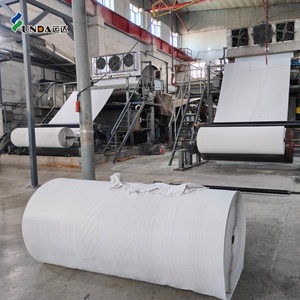
Pneumatic parent roll loading with magnetic powder brake tension control prevents web sagging, ensuring consistent embossing depth across variable paper weights (13-24 GSM).
3. Technical Specifications & Line Configurations
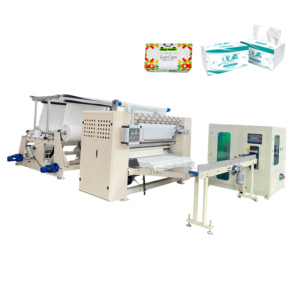
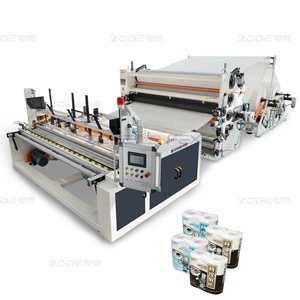
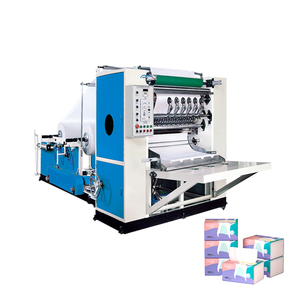
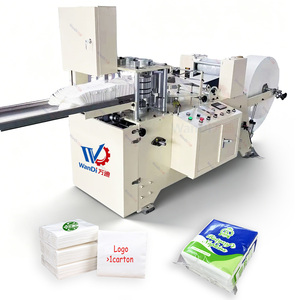
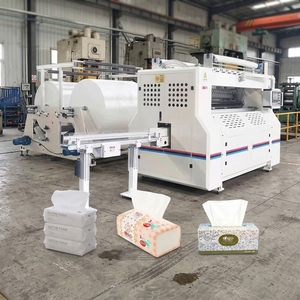
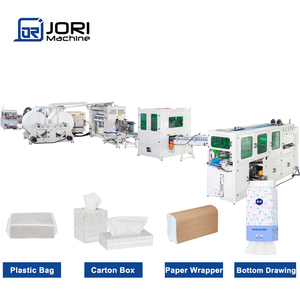
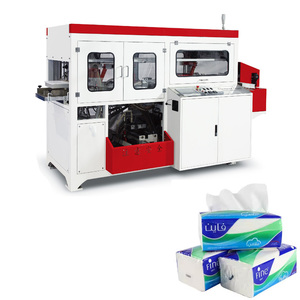
Our napkin manufacturing machinery utilizes a modular architecture, permitting converters to select precise configurations ranging from compact single-lane units tailored for small businesses to high-capacity multi-lane production lines with integrated packaging units.
| Performance Feature | Standard Napkin Machine Line | High-Speed Industrial Line | Custom Multi-Color Luxury Line |
|---|---|---|---|
| Raw Material Parent Web Width | 230mm – 300mm | 330mm – 400mm | 300mm – 500mm (Customizable) |
| Fold Dimensions (Unfolded) | 230x230mm, 300x300mm | 330x330mm, 400x400mm | 200x200mm up to 430x430mm |
| Maximum Running Speed | 500 – 800 sheets/min | 1200 – 2000 sheets/min | 1000 – 1500 sheets/min |
| Embossing Unit Type | Steel to Rubber / Steel to Paper | Point-to-Point / Nested Embossing | Custom Micro-Embossing + Logo Cliche |
| Printing Unit Capability | Optional 1-Color Flexo | Integrated 2-Color Flexo | Precision Servo 4-Color Flexo |
| Electrical Voltage Compliance | 380V / 415V, 50Hz, 3-Phase | 415V, 50Hz (GCC Standard) | 415V, 50Hz (GCC Standard) |
4. Localized Application Scenarios across Bahrain
To maximize commercial success, napkin manufacturers in Bahrain must align their machinery output capabilities with specific B2B market segments. Below are three primary operational deployment scenarios observed in the local market:
Scenario A: Luxury Hospitality & Fine Dining (Manama / Seef District)
Five-star hotel properties, corporate banquet facilities, and premium venues require heavy-weight, highly absorbent 2-ply or 3-ply 40cm x 40cm napkins featuring intricate border embossing and custom foil-like color prints. Machinery deployed in this domain requires Point-to-Point embossing rollers with steel-to-wool felt construction to deliver a linen-like tactile softness without weakening fiber strength.
Scenario B: High-Volume Quick-Service Restaurants (QSR) & Cafes
Fast-food franchises, coffee shops, and casual dining outlets prioritize cost efficiency and fast turnover. These buyers rely heavily on 1/4-fold, single-ply dispenser napkins (typically 23cm x 23cm or 30cm x 30cm). Manufacturers servicing this market utilize high-speed multi-lane folding lines configured with automatic electronic counting and stack-transfer mechanisms directly feeding continuous flow-wrapping machinery.
Scenario C: Institutional & Airline Catering (Gulf Air / Bahrain Airport Operations)
Aviation caterers and large-scale industrial catering firms operating within Bahrain demand tightly compressed, high-density interfold napkins packed in compact wrapped bundles. The machinery must integrate micro-perforation units and optical sensor counting systems to ensure exact sheet-count compliance per pack prior to final secondary carton boxing.
5. Comparative Technical Advantages: Traditional vs. Fully Automated Converting
Investing in advanced automated converting machinery yields clear competitive advantages over entry-level or legacy manual equipment commonly found in older converting setups:
- PLC Human-Machine Interface (HMI): Real-time production tracking, digital speed adjustment, and automated fault diagnostics via touch-screen control panels minimize operator error and accelerate job changeover times.
- Helical Shear Blade Cutting: Rotary shear cutting systems eliminate ragged paper edges, producing clean, sharp paper edges that enhance finished pack aesthetics.
- Automatic Web Guiding (EPC): Electronic Photoelectric Edge Position Control automatically realigns skewed parent webs in real time, dramatically decreasing paper waste during high-speed runs.
Why Industry Leaders Choose Arabia Industrial Tissue Equipment LLC
As a specialized manufacturer and global supplier of tissue paper converting machinery, Arabia Industrial Tissue Equipment LLC delivers end-to-end engineering solutions for paper converters across the Middle East, North Africa, and global export markets. Our capabilities extend beyond machinery assembly to encompass complete plant engineering, custom tooling design, and lifecycle technical support.
In-House Precision Machining
Key structural components, embossing rollers, and blade arbors are machined in our advanced CNC processing center, ensuring rigorous dimensional tolerances and long-term mechanical durability under continuous 24/7 duty cycles.
International Certification Standards
All machinery lines adhere strictly to European Safety Standards (CE Certification) and ISO 9001 quality management guidelines, providing plant managers with full operational peace of mind and workplace compliance.
GCC Service & Spare Parts Support
We maintain comprehensive spare parts inventories—including slitting blades, timing belts, pneumatic cylinders, and heating elements—with expedited regional dispatch to minimize factory downtime in Bahrain.