Engineered Converting Machinery & Complete Production Lines
Explore our high-performance tissue processing machines designed for maximum operational efficiency, low maintenance, and exact finished product specifications.
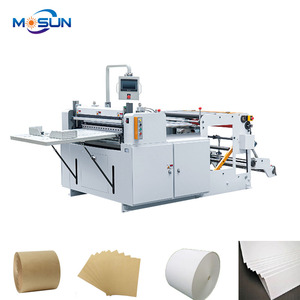
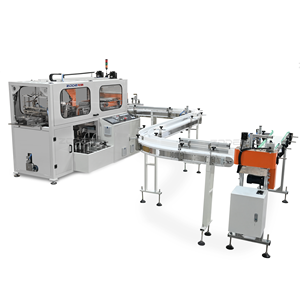
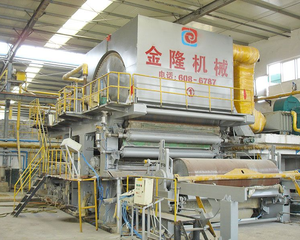
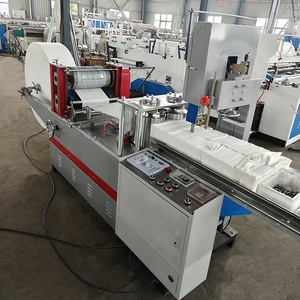
Enterprise Excellence & In-House Manufacturing Capabilities
Arabia Industrial Tissue Equipment LLC operates a state-of-the-art precision machining facility dedicated to engineering high-precision, low-vibration converting lines for global paper converters.
In-House CNC Machining Center
We process crucial dynamic mechanical components in-house—including embossing rollers, log saw drive units, and pneumatic unwinding shafts—ensuring microscopic tolerance control and long-term durability.
Tailored OEM/ODM Engineering
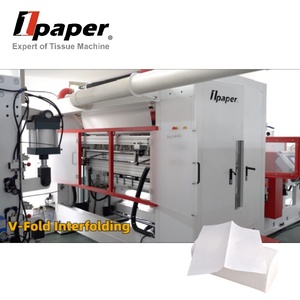
From custom parent roll widths (1.2m to 3.5m) to specific fold patterns (V-fold, N-fold, Z-fold, C-fold), flexographic color printing, and customized embossing patterns, we build machines strictly around your product dimensions.
Video-Verified Pre-Shipment Testing
Every single machine undergoes full-load continuous factory acceptance testing (FAT) using raw paper stock provided or specified by the client. HD operational video recordings and dynamic vibration analysis are provided prior to dispatch.
Industry Whitepaper: Strategic Procurement Trends in Tissue Converting Machinery
A comprehensive analysis of market dynamics, technology evolution, and Total Cost of Ownership (TCO) benchmarks for tissue paper processing infrastructure.
Shift Toward Total Cost of Ownership (TCO) & OEE Optimization
Global tissue paper converters are moving away from initial machine acquisition price as the primary procurement metric. Modern converters evaluate supplier equipment based on Overall Equipment Effectiveness (OEE), kWh consumed per metric ton of processed paper, and web breakage rates.
High-end OEM/ODM machinery integrates closed-loop tension control systems and automatic web splicing, reducing paper scrap rate below 0.8% and preventing unscheduled downtime caused by tension fluctuations in virgin or recycled parent rolls.
Modular Machinery Architecture & Rapid Product Changeover
Market demand is rapidly fluctuating between standard consumer toilet rolls, commercial jumbo rolls, facial tissue soft-packs, and multi-color printed restaurant napkins. Forward-thinking buyers demand modular converting platforms.
OEM/ODM manufacturers now supply modular slitting-rewinding frames that allow quick-change embossing cassettes, drop-in flexographic printing units, and adaptable log cutters capable of adjusting cut lengths in seconds via PLC touchscreens.
Transition to Eco-Friendly Fibers & Non-Wood Pulp Processing
With environmental regulations tightening globally, converters are increasingly running 100% bamboo pulp, sugarcane bagasse, and high-percentage recycled fiber furnish. These non-wood fibers exhibit vastly different tensile strengths and surface friction coefficients.
Next-generation tissue machines incorporate adaptive pneumatic unwinders and soft-touch rubber-to-steel embossing assemblies designed specifically to process brittle or low-tensile eco-fibers without sacrificing line speed.
Integrated Downstream Packaging & End-of-Line Automation
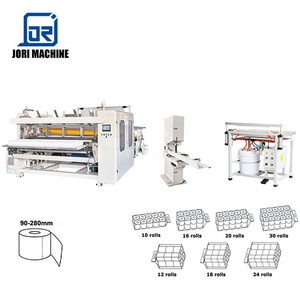
Stand-alone converting machinery creates production bottlenecks at the cutting and wrapping stages. The procurement trend strongly favors end-to-end, fully automated production lines where rewinding, log sawing, single-roll wrapping, bundle packing, and case packing operate under a unified master PLC network.
| Performance Dimension | Legacy Converting Equipment | Next-Gen OEM/ODM Smart Tissue Line | Strategic Impact on Plant ROI |
|---|---|---|---|
| Unwinding & Tension Control | Manual mechanical brakes; frequent web tearing | Servo-driven closed-loop tension sensors with auto-splicing | Reduces paper waste by up to 65%; saves 40+ min per shift |
| Log Cutting Precision | Fixed speed mechanical saw blade; friction heat buildup | Orbital band saw / log saw with active cooling & auto-grinding | Eliminates roll deformation; increases blade life by 300% |
| Changeover Flexibility | 4-8 hours mechanical re-tooling per product shift | Under 30 minutes via PLC recipe store & modular cassettes | Enables profitable short-run custom OEM customer orders |
| Energy Consumption | Standard AC motors; continuous peak power usage | IE3/IE4 energy-efficient motors with regenerative drives | Lowers electrical consumption by 18-25% kWh per ton |
Engineering Deep Dive: Technological Development Trends
How state-of-the-art automation, servo mechanics, and digital telemetry are redefining modern paper converting equipment performance.
1. Multi-Axis Motion Control & Full Servo Drives
Traditional chain-driven and gearbox-driven converting machines are being replaced by multi-axis motion control architectures. Every critical roll, perforation blade, and feeder is driven by dedicated Siemens or Mitsubishi servo motors, eliminating mechanical backlashes and lowering operational noise levels below 72 dB.
2. Intelligent Embossing & Ply-Bonding
Innovations in point-to-point and micro-nested embossing techniques increase tissue bulk, softness, and liquid absorbency by up to 30% without adding raw fiber weight. Modern embossing systems integrate pneumatic glue laminating units that prevent ply separation during high-speed rewinding and packaging.
3. IoT Telemetry & Remote PLC Troubleshooting
Equipped with edge-computing industrial gateway modules, contemporary converting machinery transmits real-time telemetry (motor temperature, vibration frequency, air pressure, roll count) directly to cloud analytics dashboards. Remote diagnostics enable overseas technicians to update PLC code and resolve issues without site visits.
Procurement & Engineering Frequently Asked Questions
Essential guidance for plant directors, procurement managers, and paper converting entrepreneurs.
Which tissue products can your machinery produce?
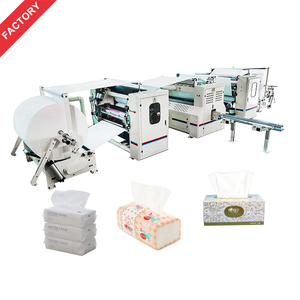
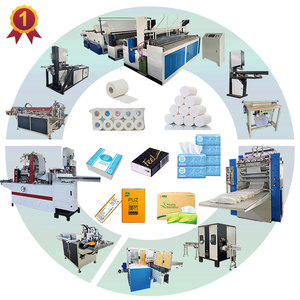
Our complete machinery portfolio processes household toilet paper rolls, center-pull rolls, maxi/jumbo industrial rolls, kitchen towels, folded napkins (with embossing and flexo printing), soft-pack and box facial tissues, hand towels, and pocket handkerchief tissues, including core making, log cutting, and wrapping.
How do I determine the right machine capacity for my factory?
Start from your target saleable finished units per 8-hour shift. Calculate backwards based on roll diameter, sheet count, GSM paper weight, log saw cuts per minute, and expected yield efficiency. Our application engineers can perform exact line-balancing calculations based on your raw paper specifications.
Can you manufacture custom OEM converting machinery?
Yes. As a direct factory manufacturer, we engineer customized machinery tailored to non-standard parent roll widths, specific voltage/frequency environments (e.g., 380V 50Hz, 415V 60Hz, 220V 3Phase), specific branding emboss logos, and specialized packaging formats.
What parameters are required to receive an exact machine quotation?
Please provide: 1) Finished product dimensions & ply count; 2) Parent jumbo roll maximum width and diameter; 3) Raw paper GSM weight range; 4) Desired production capacity (tons/day or rolls/shift); 5) Embossing or printing requirements; 6) Packing format preference (single pack, bundle pack, box).
What quality assurance and testing procedures do you follow?
Every dynamic part undergoes precision balancing and ultrasonic non-destructive testing. Assembled converting lines undergo 48 hours of uninterrupted operational testing using actual tissue paper stock before customer sign-off and dispatch.
What post-sales installation and technical support do you provide?
We deploy senior installation engineers worldwide for on-site commissioning, electrical integration, and operator training. Furthermore, we supply lifetime technical support, detailed instruction manuals, and fast-ship spare parts replacement kits.
Partner with a World-Class Tissue Machine Manufacturer
Whether you are establishing a new paper converting plant or expanding existing manufacturing capacity, our engineering team provides complete plant layout design, equipment sizing, and custom OEM manufacturing.