Product Portfolio
High-Performance Facial Tissue & Paper Machinery
Explore China’s leading industrial converting equipment—engineered for maximum Overall Equipment Effectiveness (OEE), minimal scrap rates, and long-term mechanical reliability.
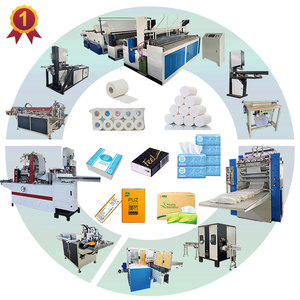
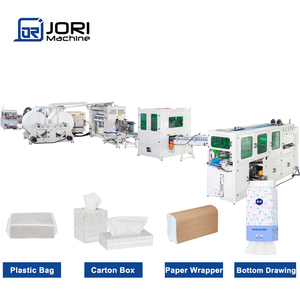
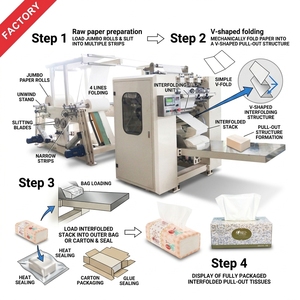
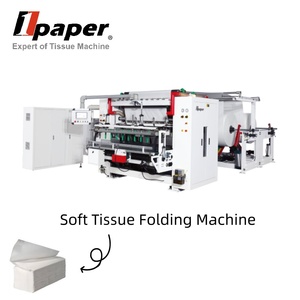
1,200+
Packs/Min Packing Capacity
99.2%
OEE Operating Efficiency
±0.5mm
Log Saw Cutting Precision
65+
Global Export Countries
Industry Technical Guide
The Evolution of High-Speed Facial Tissue Packaging Machinery in China
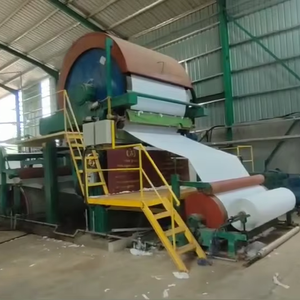
The global tissue converting landscape has undergone a major paradigm shift. Tissue paper processing—once defined by manual transfer and semi-automated cutting—now demands ultra-high-speed continuous integration. Modern converters across North America, Europe, the Middle East, and Latin America are replacing legacy machinery with fully automated Chinese facial tissue folding and packaging lines. Driven by breakthroughs in multi-axis servo-motion control, vacuum-assisted interfolding, and machine-vision inspection systems, leading Chinese OEMs now deliver machinery that rivals European benchmarks at a significantly optimized Total Cost of Ownership (TCO).
This comprehensive engineering guide analyzes the structural design, operational parameters, sourcing trends, and procurement strategies for modern facial tissue packaging systems, soft-pack tissue lines, and complete converting facilities.
1. Architectural Breakdown: Interfolding to Primary & Secondary Packaging
A fully automated facial tissue production line operates as a continuous kinematic chain. To eliminate bottlenecking and preserve paper web integrity, each process module must maintain millisecond-level synchronization:
- Parent Roll Unwinding & Tension Control: High-capacity jumbo roll stands feature dynamic pneumatic braking and closed-loop tension sensors. Automatic web-guiding alignment prevents web displacement even when operating at speeds exceeding 200 m/min.
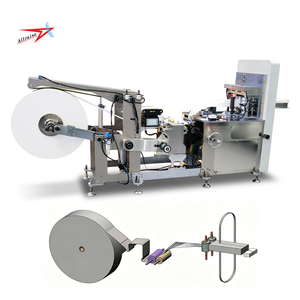
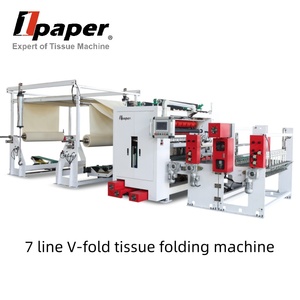
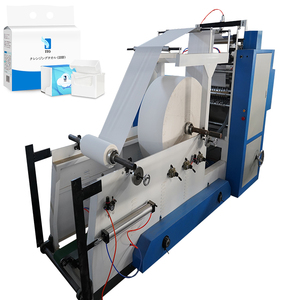
- Vacuum-Assisted Interfolding (V-Fold / Z-Fold / W-Fold): Precision folding cylinders utilize targeted vacuum suction to lock tissue plies into position during interfolding. This mechanism ensures crisp fold geometry without damaging ultra-soft 12.5–15 gsm tissue fibers.
- High-Speed Multi-Lane Log Saw Cutting: Servomotor-driven orbital or band saw log cutters perform precision transversal cuts. Dual-blade grinding systems maintain continuous sharpening during operation to prevent edge tearing.
- Primary Soft-Pack Overwrapping: Individual tissue stacks are introduced into high-speed wrapping units. Servo-guided film feeding applies CPP, PE, or BOPP films around the tissue stack, completing bottom and side heat-sealing with micro-temperature control (±1°C).
- Secondary Bundle Wrapping & Box Cartoning: Individual packs are collated into 5-packs, 10-packs, or custom retail configurations using high-speed bundling machinery or auto-adjusting cardboard cartoning units.
Multi-Axis Servo Motion
Eliminates mechanical gear wear through synchronized electronic cam motion, enabling seamless size changeovers and reducing downtime by up to 60%.
Machine Vision Inspection
Integrated optical cameras automatically detect web tears, misaligned seals, incorrect pack counts, and foreign particles, ejecting sub-standard packs at full speed.
Energy-Optimized Vacuum
Variable-frequency drive (VFD) vacuum pumps reduce electrical power consumption by up to 25% while matching suction pressure dynamically to paper basis weight.
Engineering Specifications
Comparison Matrix: Facial Tissue Packing Configurations
Selecting the optimal equipment tier depends on target daily throughput, labor allocation, and packaging materials.
| Performance Parameter | Semi-Automatic Entry Level | High-Speed Automatic Line | Turnkey Ultra-Speed Integrated Line |
|---|---|---|---|
| Target Output (Packs/Min) | 30 – 60 packs/min | 100 – 180 packs/min | 200 – 350+ packs/min |
| Interfolding Lanes | 2 – 4 Lanes | 6 – 10 Lanes | 12 – 18+ Lanes |
| Control Architecture | Basic PLC + Touch Screen | Siemens / Beckhoff Motion PLC | Full Servo Bus Control (EtherCAT) |
| Applicable Paper GSM | 13 – 18 gsm (2-3 ply) | 11 – 16 gsm (2-4 ply) | 11 – 18 gsm (1-4 ply Virgin/Bamboo) |
| Packaging Material Compatibility | PE, CPP Pre-cut bags | Roll film (PE, CPP, BOPP) | Recyclable Monomaterial, Paper Film, PE |
| Log Saw Cutting Tolerance | ±1.0 mm | ±0.5 mm | ±0.2 mm (Servo-Driven Orbital Blade) |
| Direct Labor Requirement | 3 – 5 Operators | 1 – 2 Operators | 1 Supervisor (Full Line Automation) |
| Estimated OEE Benchmark | 82% – 88% | 90% – 95% | 96% – 98.5% |
Market Outlook & Strategic Trends
Facial Tissue Machinery Procurement Trends (2026–2030)
Global tissue converters must adapt to changing consumer behaviors, stricter environmental regulations, and rising raw material costs. Sourcing strategies are shifting toward equipment platforms that offer flexibility, sustainability, and digital integration.
A. Sustainable & Eco-Friendly Packaging Transitions
Single-use plastics face increasing regulatory scrutiny worldwide. Leading Chinese machine manufacturers are engineering sealing mechanisms capable of handling ultra-thin mono-polyethylene (PE), bio-based PLA films, and paper-based wrapping materials without film tearing or seal burning. Advanced heating technology precisely regulates sealing temperatures, enabling rapid switches between traditional plastic films and recyclable paper overwrap.
B. Rapid Shift to Alternative Fibers (Bamboo & Straw Pulp)
Due to the price volatility of virgin wood pulp, tissue producers are expanding production of bamboo pulp, sugarcane bagasse, and recycled fiber tissues. However, alternative fibers feature different tensile strength, surface friction, and dust generation properties. Next-generation folding machines incorporate specialized dust extraction shrouds, anti-static ionizers, and soft-touch feed belts to handle non-wood pulps without web breaks.
C. Industry 4.0 Telemetry & Remote Diagnostics
Unplanned downtime remains the single largest margin erosion factor in tissue converting. Top-tier Chinese machinery exporters now integrate IoT edge gateways and cloud diagnostic platforms. Real-time vibration sensors on main drive shafts, motor temperature monitors, and automated blade-wear indicators alert maintenance teams before mechanical failures occur. Overseas engineers can also perform firmware updates and troubleshoot PLC logic remotely.
D. Modular Machine Architecture & Footprint Optimization
Modern tissue converting plants require agile machinery layouts. Factory designs are shifting away from rigid, linear footprints to modular, L-shaped, or U-shaped line configurations. Modular conveying channels allow converters to add automatic bundle stackers, case packers, or robotic palletizers as market demand grows.
Enterprise Purchasing Advice: Total Cost of Ownership (TCO) vs CapEx
When evaluating Chinese tissue machinery manufacturers, savvy buyers look beyond initial capital expenditure (CapEx). A low upfront machine purchase price can easily be negated by high scrap rates, frequent spare part replacements, and long changeover times. Evaluating suppliers on frame rigidness (e.g., solid 45mm wallboards vs welded tubing), brand tier of pneumatic/electrical components (SMC, Schneider, Siemens, Yaskawa), and local technical support availability yields the highest lifetime return on investment.
Why Partner With China’s Top Exporters
Manufacturing Infrastructure & Quality Control Standards
China's premier machinery manufacturers combine robust mechanical engineering with precision production facilities.
In-House CNC Machining
Key components—including folding rollers, knife cylinders, and heavy-duty frame wallboards—are machined in-house on 5-axis CNC centers to guarantee micro-level mechanical tolerances.
Full Factory Acceptance Testing (FAT)
Every line undergoes rigorous 72-hour continuous trial runs using the client’s target paper stock and film specifications. Video verification and speed runs are completed prior to shipment.
Global Compliance & Safety Certification
Machinery meets stringent international compliance standards, including CE Directives (MD 2006/42/EC, LVD, EMC) and UL electrical enclosure safety requirements.
Buyer Knowledge Base
Frequently Asked Questions (FAQ)
Essential answers for plant engineers, procurement managers, and tissue business investors.
What primary factors dictate the speed and capacity of a facial tissue packaging line?
The output rate is determined by three main elements: the number of interfolding lanes (e.g., 4, 6, 8, 12, or 16 lanes), the log saw cut speed (measured in cuts per minute), and the single-pack wrapping machine's film-feeding capability. For example, a 10-lane interfolding machine running at 1,000 sheets/lane/min yields 10,000 sheets/min. If each pack contains 100 sheets, the downstream log saw and overwrap unit must comfortably handle 100 finished packs per minute without jamming.
Can a single facial tissue packing machine handle both soft-pack film and hard-box cartoning?
While the initial interfolding and log saw cutting stages are identical for both soft-pack and box-pack tissues, the primary packaging machinery differs. Soft-pack tissues utilize continuous film overwrapping units, whereas box facial tissues require automated carton erecters, pushers, and tuck-in/hot-melt glue sealers. Converters seeking flexibility can install a modular diversion conveyor after the log saw, allowing tissue logs to be directed to either a soft-pack wrapper or a cartoning machine depending on production schedules.
What raw material technical parameters must be provided when requesting a machine quotation?
To ensure precise machine calibration and custom tooling, buyers should provide: (1) Parent roll width, maximum diameter, and core diameter; (2) Basis weight (GSM) per ply and ply count (e.g., 2-ply 13.5 gsm or 3-ply 14 gsm); (3) Paper tensile strength and fiber source (Virgin pulp, Bamboo pulp, or Recycled fiber); (4) Target opened tissue sheet dimension and folded size; and (5) Desired pack count ranges (e.g., 50 to 200 sheets per pack).
How do Chinese tissue machine manufacturers handle overseas installation, commissioning, and training?
Established Chinese exporters offer comprehensive installation support. Factory-trained service engineers are deployed overseas to supervise foundation placement, electrical wiring, pneumatic connections, and mechanical alignment. Engineers remain on site to conduct operator training—covering PLC navigation, film thread-up, blade sharpening, and routine preventive maintenance—until local machine operators achieve target OEE benchmarks.
What is the typical lead time for a custom facial tissue converting and packing line?
Standard standalone equipment (such as small napkin folders or semi-automatic wrappers) typically ships in 30 to 45 days. Fully customized, high-speed multi-lane lines—featuring automatic web splicing, embossed folding cylinders, orbital log saws, and inline bundle packaging—require 60 to 90 days. This allows adequate time for precision machining, electrical panel wiring, assembly, and rigorous 72-hour FAT testing.
Transform Your Tissue Converting Operations Today
Partner with China’s premier engineering teams to design a custom high-speed facial tissue folding, cutting, and packaging line tailored to your market demands.